From The Religious Education Coordinator
 ENCYCLICAL LETTER
MAGNIFICA HUMANITAS
OF HIS HOLINESS
POPE LEO XIV
ON SAFEGUARDING THE HUMAN PERSON
IN THE TIME OF ARTIFICIAL INTELLIGENCE
The Pope’s Encyclical was released yesterday. The link is below:
https://www.vatican.va/content/leo-xiv/en/encyclicals/documents/20260515-magnifica-humanitas.html
The encyclical “Magnifica Humanitas” (Magnificent Humanity), issued by Pope Leo XIV on May 15, 2026, is a landmark document in the Church’s Social Doctrine, specifically addressing the challenges and opportunities presented by the rapid advancement of Artificial Intelligence (AI), robotics, and digitalization.
The letter commemorates the 135th anniversary of Pope Leo XIII’s Rerum Novarum (1891) and seeks to apply the Gospel to the “new things” (res novae) of the 21st century.
A visual summary from the Vatican: https://www.youtube.com/watch?v=PvU6NFe0z6k
Here is a summary of the key points from the Encyclical:
1. The Biblical Framework: Babel vs. Jerusalem
The Pope uses two biblical images to illustrate the choice facing modern humanity:
- The Tower of Babel: Represents the “technocratic paradigm”—a world built on pride, uniformity, and efficiency that ignores God and sacrifices human diversity and dignity for power.
- The Rebuilding of Jerusalem (Nehemiah): Represents “communion”—a project where every person has a role, relationships are prioritized over structures, and the work is centered on God and the common good.
2. Technology and the “Technocratic Paradigm”
The encyclical acknowledges that while AI is a “valuable tool” and a product of human creativity, it is never neutral. It reflects the values of those who create and fund it.
- The Problem of Power: The Pope warns that technological power is increasingly concentrated in the hands of private, transnational entities that often bypass the governance of sovereign states.
- Transhumanism and Posthumanism: The document strongly critiques ideologies that seek to “surpass” the human condition through technology, asserting instead the “grandeur” of the human person as an image of the Triune God.
3. Truth, Work, and Freedom
The encyclical devotes significant attention to how AI reshapes social structures:
- Ecology of Communication: It calls for the protection of “truth as a common good” against deepfakes and algorithmic manipulation that threaten democracy.
- Dignity of Work: Addressing the fear of mass unemployment due to automation, the Pope insists that work is not merely a means of production but a fundamental aspect of human dignity. He calls for an economy that values the “person over the machine.”
- New Forms of Slavery: The Pope warns against “digital dependencies” and the commercialisation of the human person through data exploitation.
4. The “Civilisation of Love” vs. AI Warfare
A major portion of the document focuses on the “normalisation of war” and the dangers of Autonomous Weapon Systems (AWS).
- Disarmament of Words: The Pope calls for a “healthy realism” in diplomacy and the “disarmament of words” in digital spaces to prevent the polarization that leads to conflict.
- Multilateralism: He advocates for international treaties to regulate AI and ensure it is never used to dehumanize the “perspective of victims” in war.
5. Foundations of Social Doctrine
The Pope reiterates the four pillars of the Church’s social teaching as the “standards for discernment” for AI:
- Dignity of the Human Person: The central focus.
- The Common Good: Ensuring technology benefits all, not just an elite few.
- Subsidiarity: Preventing technological systems from replacing local decision-making and human agency.
- Solidarity: Using digital tools to bridge gaps between the rich and the poor.
Conclusion: The “Construction Site” of Our Time
Pope Leo XIV concludes by calling on the faithful to be “builders of communion” rather than “architects of Babel.” He invokes the Magnificat (the Song of Mary) as a reminder that true greatness comes from God lifting up the lowly, urging humanity to ensure the “human heart” remains the place where God desires to dwell, even in a digital age.
Key Takeaway: The encyclical argues that while AI can heal and connect, it must be governed by an “algor-ethics” (algorithmic ethics) that prioritizes the human person, safeguards the vulnerable, and prevents technology from becoming a new tool of dominance
Adapted from: https://www.vaticannews.va/en/pope/news/2026-05/pope-leo-xiv-encyclical-magnifica-humanitas-ai.html
A Prayer for Magnifica Humanitas
Merciful and loving God,
You created humanity in Your own divine image and likeness, breathing into us the grandeur of a magnificent spirit. We thank You for the gifts of intelligence, creativity, and community.
In an age of rapid technological advancement and artificial intelligence, guide our hands and our hearts. Grant us the wisdom to ensure that our innovations serve to elevate the human person rather than diminish our innate dignity.
Protect us from the temptation to disengage from the real world, and help us to always seek You in the living, breathing faces of our neighbors. Give us the courage to be weavers of hope, prioritising compassion, justice, and solidarity over pure efficiency and power.
May we recognise that our true magnificence does not lie in technical mastery, but rather in our capacity to love, to care for the vulnerable, and to be brothers and sisters to one another.
Lord, keep us profoundly human. Help us to build a civilisation of love and peace, brick by loving brick, so that we may see Your glory revealed in all creation.
Amen.
Marist Sony Camp Reunion
 In December, ten Marist Sisters’ College students joined twenty boys from St Joseph’s College and ten girls from Loreto Normanhurst for four unforgettable days at the Marist Sony Camp. Together, we supported children with a wide range of abilities, helping them experience joy, independence, and friendship through a huge variety of activities. From face painting and water slides to magic shows, dancing, singing, unicorn visits, a jumping castle, and a festive Christmas party complete with elves, every moment was filled with energy and excitement.
Throughout the camp, we learnt invaluable skills in patience, empathy, teamwork, and communication. Caring for our companions challenged us in meaningful ways, but it was equally rewarding to see their confidence grow and to share in their joy.
On Thursday 21 May, we reunited at St Joseph’s College for a reflection evening. Over a shared meal, we completed a booklet capturing what we found challenging, enjoyable, and most memorable. It was a chance to reconnect with the friends we made along the way and to appreciate just how special the Sony Camp experience truly was for all of us.
By Alice Jones
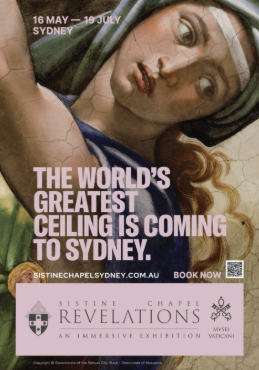
 Sistine Chapel Exhibition – Sydney
https://sistinechapelsydney.com.au/
Created with the express permission of the Vatican Museums, the Sistine Chapel Exhibition: Revelations is a world-first Sistine Chapel Experience bringing one of the world’s greatest artistic achievements to life through a spectacular immersive experience in Sydney. Using cutting-edge projection technology and ultra-high-resolution imagery sourced directly from the Vatican archives, this is more than a Michelangelo exhibition. It transforms the art of the Sistine Chapel into a breathtaking art exhibition Sydney has never seen before.