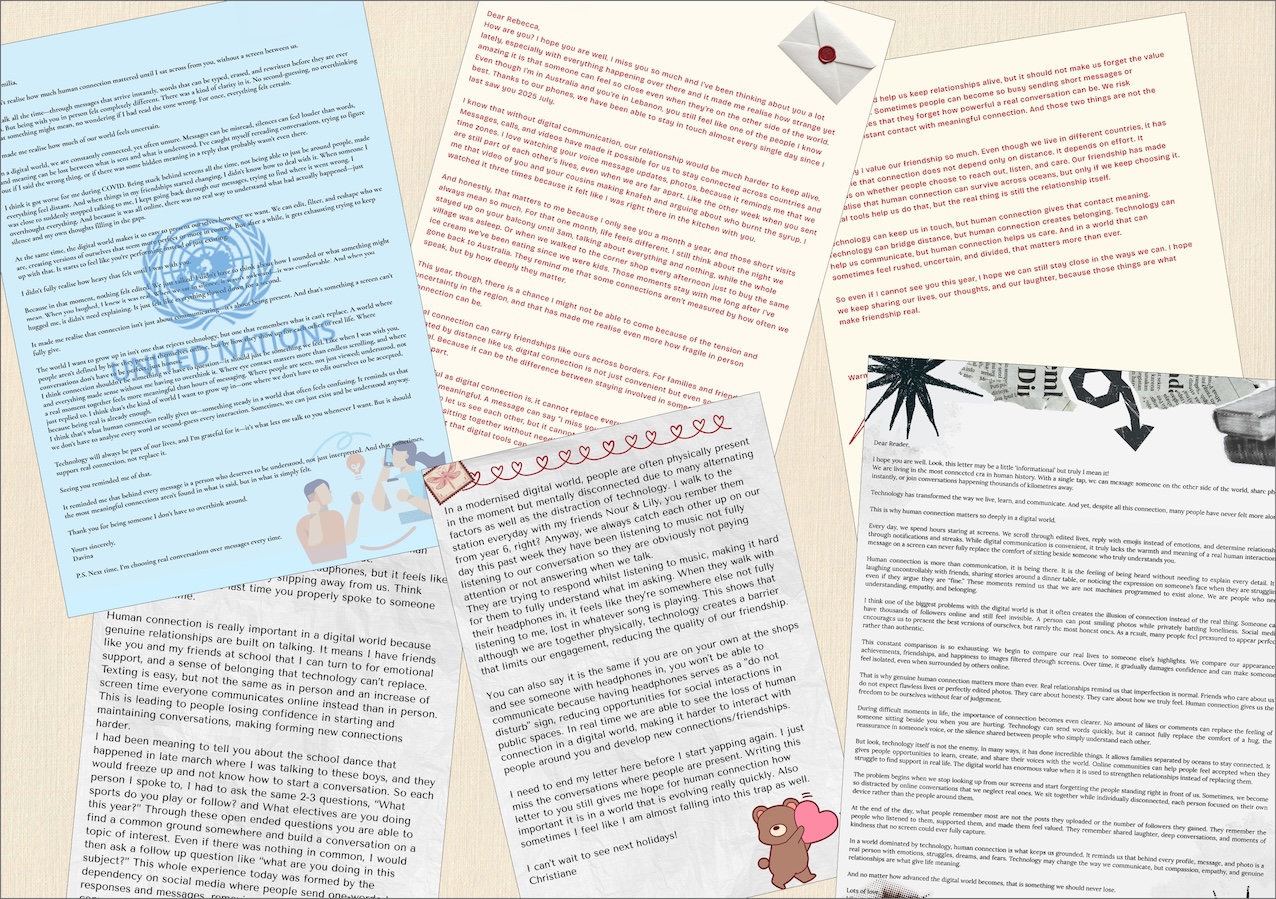
Letter writing and human connection
‘During Term 1, four students from Years 10-11 in the Entrepreneurial Sustainability Start-Up club prepared entries for the UPU International Letter Writing Competition for Young People. This year’s theme asked them to write a letter to a friend about why human connection matters. During club meetings, students explored how technology and social media shape communication today and why genuine human connection remains so important. Students reflected on their own experiences and used these insights to craft thoughtful and personal letters addressing this social issue. Their letters were creative and well articulated. I want to acknowledge the hard work each student put into this project and congratulate them on their accomplishments on entering this international competition.
Student Reflections
Writing for the UPU Letter writing competition has allowed me to reflect on how rapidly our society is changing in a modern-day world. For the International Letter-Writing Competition, this year’s topic was ‘why human connection matters in a digital world.’ Within this topic, I chose to write about the loss of conversation amongst young people my age. By doing so I have been able to reflect on situations where I have experienced these changes first hand reflecting on the importance of maintaining human connections. These letters have been a work in progress since Term 1, meeting with Ms Lam and other members of the club during lunchtimes to discuss important points and share ideas for our letters with our peers as well as writing our letters in our own time.
Christiane Nikolaou
Writing a letter to the United Nations for the UPU International Letter Writing Competition was a truly meaningful and enjoyable experience for me. Coming up with my ideas took a lot of thought and I spent time reflecting on what message I wanted to communicate and how to express it in a clear and powerful way. Throughout the process, there were many discussions and constant edits, as I kept refining my writing to improve my clarity, tone and structure. My teacher was incredibly supportive and helpful, offering thoughtful feedback, encouragement and guidance at every stage. Their advice helped me see my writing differently and pushed me to improve with each draft. Although the process was challenging at times, it was also exciting and rewarding, and I gained confidence in my writing skills. Overall, it was a new experience that I truly enjoyed and learned a great deal from.
Davina Rajkumar
The letter writing competition allowed me to slow down and think deeply about what human connection really means in a world where so much of our communication happens through screens. I chose to write to my long distance friend Rebecca, who lives in Lebanon. Although we don’t see each other often, technology has allowed us to maintain and strengthen our friendship.
The central theme of my letter is the contrast between digital connection and real, in person human connection. I explored how technology allows relationships to survive across borders, but also how it can never fully replace physical presence. This theme came naturally because my friendship with Rebecca exists across two countries, Australia and Lebanon, and our relationship depends heavily on digital communication.
While writing, I found myself returning to two key ideas:
- Technology keeps people connected, especially when distance or conflict makes it difficult.
- Human connection is irreplaceable, because physical presence carries emotions, memories and experiences that screens cannot replicate.
This theme became clearer as I wrote, especially when I included specific memories. These moments helped show the difference between digital and real lfe connection.
Writing this letter taught me several things about communication, relationships and the writing process itself. Personal stories make themes stronger. When I added real memories, the message felt more meaningful. Distance changes relationships, but effort keeps them alive. While writing, I realised how much intentional communication matters, not just messages, but choosing to stay involved. Reflection helps uncover deeper meaning. At first, I thought I was just writing about missing a friend. But as I revised, I saw that the letter was really about how fragile and valuable human connection is. Writing can clarify emotions. Putting my thoughts into words helped me understand my own feelings about distance and belonging.
Overall, the letter writing process helped me express that technology can bridge distance, but only human connection gives relationships their real meaning. Writing this letter reminded me that friendships survive not because of Wi‑Fi or messages, but because people choose to care, to reach out and to stay connected even when life makes it difficult.
Nour Charbel
I wrote this letter to explore the growing realities of digital communication within the contrasting of human interaction. Through experiences and memories, technology continually becomes more integrated within an individual’s life, where people are constantly connected online and yet people experience the lack of loneliness and disconnection in real life. I wanted to give voice in my letter to reflect the difference and to encourage my reader to realise that on a deeper level, the true importance of relationships within a world readjusted to screens.
My main intention was to create an emotional piece rather than an academic or formal piece. In choosing my specific letter format, I have intentionally made it feel personal and direct as though I am speaking to the reader and not presenting information. In doing so, this has helped me communicate ideas in my own way, matching the central idea of the letter.
Throughout the letter, I use examples from my experience, like messaging, being on social media and spending time on phones, because they are an experience so familiar to myself and many others in our daily lives. Through this, I would hope that my reader could recognise multiple aspects of their lives in how technology affects relationships and emotions. I also intended to contrast digital communication with physical presence, like eye contact, laughter and shared silence – to highlight the fragility of emotional depth and how a device could never compare.
Although my main intention was to explore the importance of reality rather than formality. I also wanted to challenge the assumption that by being digitally connected automatically means people are emotionally connected. I wanted to show that social media constantly creates pressures to appear perfectly normal, meanwhile people hide their true emotion. This idea was highly important to include in my letter as mainly young people, compare themselves to unreliable online standards and feel isolated as a result.
Though my letter seems to be highly negative of technology, instead I try to aim toward a balanced perspective by acknowledging the positive aspects of the digital world. Like helping people stay in contact across long distances and forming communities online. With the inclusion of this characteristic. By including this balance, I intend to make my argument realistic and considerable rather than one-sided.
Overall, my letter to my intended friend is to remind them that while technology is powerful and useful, it shouldn’t replace human interactions. I wanted it to be reflective of encouraging people to value empathy, emotion and real connections in their day to day lives.
Lily-Rose Sulukojian
Vanessa Lam
Business Studies and Commerce Teacher