


Gospel Reflection
The Gospel this Sunday brings us into a moment of surprising tension: a Canaanite woman cries out for help and Jesus at first seems silent even dismissive, yet she persists. She refuses to believe that God’s mercy could ever be limited to certain people or certain boundaries. Her boldness becomes an act of faith so strong that Jesus stops, listens and responds: “Woman, great is your faith.”
This encounter reveals something essential about God’s heart. Isaiah tells us that God’s house is “a house of prayer for all peoples” and Paul reminds us that God’s mercy is “for all.” The Canaanite woman shows us what this looks like in real life. God’s love breaks through human borders, cultural divisions and assumptions about who is “worthy.” Her faith is not polished or perfect, it is desperate, courageous and honest, and Jesus meets her there.
For us, this Gospel asks a simple but challenging question, Do we believe God’s mercy is truly for everyone? Not just for those who look like us, think like us, or live like us, but for the outsider, the overlooked, the persistent voice calling out for compassion. The woman’s faith reminds us that sometimes the people we least expect become our greatest teachers in trust, humility and hope.
May we be people who never limit God’s mercy and who, like the Canaanite woman, keep calling out to Jesus with confidence that He hears us.
Our Ursuline Connections
This week, I was shared the remarkable story of Sister Elisabeth Ansart. Ursuline Sister Elisabeth Ansart, a French Ursuline travelled to Calais, she stepped into one of the most complex humanitarian frontiers in Europe. Calais is a place where thousands of migrants gather, hoping to cross the narrow stretch of water that separates France from the United Kingdom. For many, it represents both the final step toward safety and a painful reminder of how difficult that step can be. In this challenging environment, Sister Elisabeth offered what she describes as “simple acts of dignity”, presence, listening and compassion.
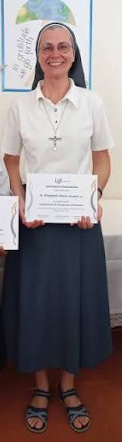 During her ten days in Calais, Sister Elisabeth worked alongside volunteers who provided essential services, including hot drinks, clean clothing, showers, phone charging stations and safe spaces for rest. Yet her most significant work happened in the quiet conversations and human encounters that unfolded each day. She met young men fleeing conflict in Sudan, mothers from Somalia and Eritrea, and teenagers travelling alone. Their stories revealed the harsh reality of life in Calais; camps dismantled overnight, belongings taken, constant police pressure, and dangerous attempts to cross the Channel.
What struck Sister Elisabeth most was the resilience of the people she met. Despite fear and uncertainty, they held onto hope. She saw how volunteers, religious and non‑religious, lived the Gospel through solidarity, kindness and a refusal to look away from suffering. Her time in Calais reminded her that God is found not only in churches and classrooms but also in the peripheries where people struggle, dream and endure.
For our College community, Sister Elisabeth’s witness is a powerful reminder of the Ursuline tradition we inherit. Her courage was not dramatic, it was steady, compassionate and grounded in the belief that every person is worthy of dignity. In a world that often labels migrants as problems, she chose instead to see their faces, their stories, and their humanity.
Sister Elisabeth’s experience invites us to reflect on how we too can respond to the needs of others with presence, with kindness, and with the conviction that hope can grow even in difficult places.
Sister Elisabeth’s witness in Calais also echoes the heart of our College’s long‑standing relationship with the Sisters in Cambodia. Just as she offered dignity and presence to displaced people on the northern coast of France, our community continues to support the Cambodian ministries that accompany families facing poverty, instability, and displacement. The same Ursuline spirit that animates the work in Calais — compassion, solidarity, and a commitment to seeing Christ in those on the margins — is the foundation of our partnership with the communities in Cambodia. Her experience reminds us that whether in Calais or Cambodia, the call is the same: to stand with those who are vulnerable and to respond with courage, tenderness, and hope.
As a community, we gather on St Ursula’s Day to reflect and celebrate the courage of St Ursula and the way she stood up for what she believed in, even when the world expected something different. St Ursula shows us that faith can inspire ordinary people to do extraordinary things. We are encouraging every student to make a $20 donation which will directly support the work of the Ursuline sisters in Cambodia. The link you need is here.
