

Leader of Learning – Integrated Curriculum, Pedagogy and Assessment – Lisa Romberg
A special welcome to the 2026 academic school year, especially our families that are new to the College. We hope that your daughter has enjoyed her first weeks at OLMC.
Assessment Handbooks
Please take time to read the Assessment Handbook with your daughter’s, taking note of assessment dates using the term planners. Links to these are provided in the table below.
We ask that if you have regular medical/dental appointments, please try and avoid dates of assessment tasks. If you are able to reschedule any appointments that have already been made, that would be appreciated.
We encourage you to be aware of the expectations of your daughter if she is absent for a task.
Taking responsibility for her own learning is part of your daughter’s educational journey, thank you for supporting us in assisting your daughter grow in this area.
Absent from an Assessment Task
The assessment handbooks will be published shortly for each Year Group. I will send an email letting students and parents know when each Year Group is published.
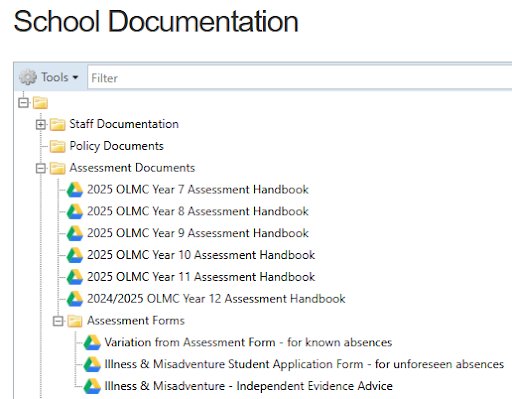
LOCATIONS:
College Website → College Life → Student Life→ then under each Year Group Heading
COMPASS → Community → School Documentation
Medical Certificates required for Year 9-12 students
For students in Years 9-12, a medical certificate is required for each assessment task missed. These can be obtained from a doctor or a pharmacist. Students who continue to miss assessment tasks throughout the year will have their names submitted to the academic review panel.
When a medical certificate is supplied, the school reserves the right to review the result in light of all assessment tasks for that subject.
The certificate is to provide information on the nature of the diagnosis and how this impacts on student preparation or performance in the assessment.
WHEN IS A MEDICAL CERTIFICATE REQUIRED?
- A Medical Certificate is required if a student is partially absent on the day of a scheduled in-class assessment task or if a student is absent the day before an assessment task.
- A Medical Certificate is required if a student is unwell during the Assessment Task as the illness may have impacted on the student performance. The student is to notify the class teacher, Instructional Leader of Curriculum or Leader of Learning of their illness on the day of the in-class task.
- A Medical Certificate is also required for all missed Assessment Tasks as outlined above.
Summary of Missed Assessment Task expectations and Term Schedules
| Year Group | Summary: Missed Assessment Task Expectations | Term Schedules | |
| 7 | Illness/Misadventure: Note from home to class teacher Known Absence: Due to Leave, Sports representation, Specialist Appointments other…. Application for Leave to the PrincipalVariation of Assessment Form Section VA – Student form | Term 1 linkTerm 2 link | Term 3 link Term 4 link |
| 8 | Term 1 link Term 2 link | Term 3 link Term 4 link | |
| 9 | Unforeseen Absence 9-12 Illness/Misadventure: College Illness Misadventure Section A – Student form AND Independent supporting evidence such as a Medical Certificate covering complete absence Independent Evidence of Illness or Misadventure Advice Known Absence 9-12 Due to Leave, Sports representation, Specialist Appointments other…. Application for Leave to the Principal Variation of Assessment Form Section VA – Student form | Term 1 linkTerm 2 link | Term 3 link Term 4 link |
| 10 | Term 1 linkTerm 2 link | Term 3 link Term 4 link | |
| 11 | Term 1 linkTerm 2 link | Term 3 link | |
| 12 | Term 1 linkTerm 2 link | Term 3 link | |
Communication Channels
At OLM Catholic College Burraneer we value the partnership between school and home in assisting each student to thrive as a learner. Should you wish to discuss your daughter’s learning or wellbeing, we ask that you use the appropriate communication channel.
Contact details for the College Leadership Team, the Instructional Leaders, Curriculum and Wellbeing and other key staff members can be found at the beginning of all Assessment Handbooks
| Communication channel | Learning | Wellbeing |
| First point of contact | Classroom Teacher To discuss your daughter’s learning in a subject. | Homeroom Teacher To discuss your daughter’s wellbeing and school life. |
| Second point of contact You’re seeking clarification on your first level of contact. | KLA Instructional Leader Can assist with questions about assessment tasks, subject content or overall learning in a subject. | Instructional Leader of Wellbeing Can assist with specific issues related to your daughter’s wellbeing at home or school. |
| Third point of contact You’re seeking clarification on your second level of contact. | Leader of Learning, Curriculum, Pedagogy & Assessment Can assist with concerns across subjects or tasks. | Leader of Wellbeing – Assistant Principal Can assist with complex or consistent wellbeing concerns alongside ILWs. |
| Fourth point of contact You’re seeking clarification on your third level of contact. | Assistant Principal | |
| Fifth point of contact | Principal | |
Home Learning
Home Learning is vital to equip students to be effective independent learners, as well as to consolidate knowledge learned in school time. Students need to practise study skills, learn how to manage their time and ensure that spaced revision becomes habitual rather than incidental. Home study is especially valuable for focusing areas of weakness that can become cemented if not addressed. Teachers can individualise and facilitate this process if the student is able to articulate the areas in which they are struggling well before formal assessments reveal the difficulty. Home study helps students learn how to prioritise tasks, problem solve and take responsibility for their own learning. It is also an important way for parents to be part of the learning process and to emphasise and value that learning is an ongoing endeavour.
Home Learning Guidelines:
Stage 4: Students should be spending up to 1½ hours per night on home learning
Stage 5: Students should be spending up to 2 hours per night on home learning
Stage 6: Students should be spending between 2½ to 3 hours per night on home learning
HOME LEARNING – WHAT CAN STUDENTS DO?
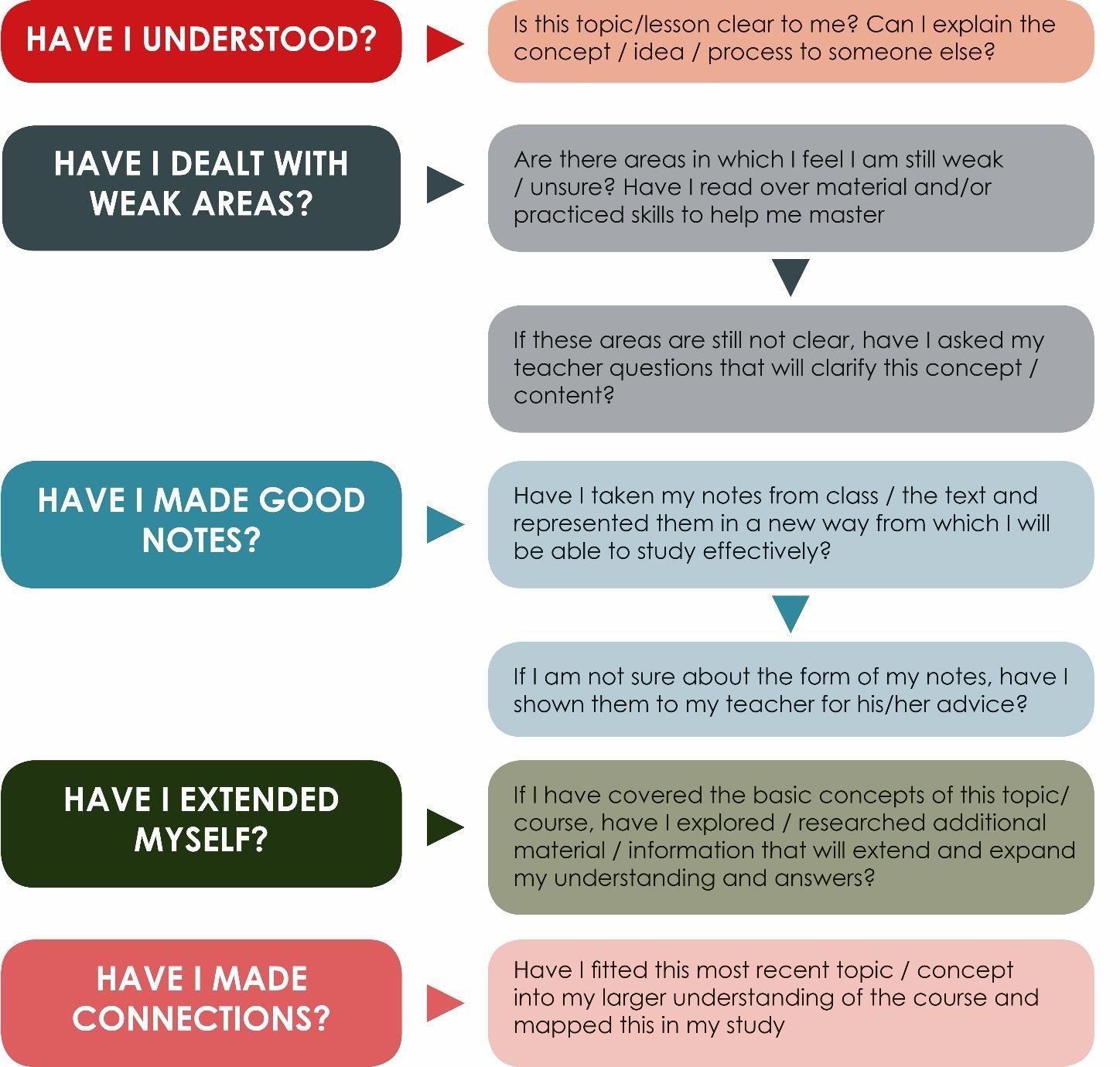
Write questions to clarify
If there are areas that need clarification students should write down those questions so that they can ask their teacher the next day.
Read Ahead
Students should read ahead in their textbooks, read their prescribed text or read relevant source material well before this material is addressed in the classroom. This will assist them when they come to the content in class as the information is more familiar to them.
Prepare study summaries
Students should prepare study summaries each week. Some subjects have very specific content that must be learnt, and dot point summaries in these subjects can be highly beneficial. Summaries should be brief and concise, they should be “written” in a way that best suits the students learning style(s). Pictures, tables, mind maps, short notes, flow carts can all be used. Simply re-writing notes without modification or adaptation is not helpful.
These summaries should be reviewed on a regular basis so the content is lodged in the long term memory.
Past Papers (especially for Years 11 and 12)
Students should prepare for examinations by completing Past Papers. These should be done twice.
The first time students should review their study summaries and then put them away. They should then complete the Past Paper without looking at their summary. They should make sure they use techniques taught in class to unpack the question, brainstorm technical terms and scaffold an answer.
The second time they do the Past Paper they should change the pen colour that they use and complete the paper with their study notes, class notes and text book. They should remember to add any technical terms missed. This process helps refine whether they know the content or not.
Wednesday Afternoon Open Learning
Our Afternoon Open Learning has moved to Wednesday this year and will start on 18 February 2026. This will be held in the Library each Wednesday afternoon from 3pm until 4pm.
This time will provide students with the opportunity to collaborate with fellow students, complete any group tasks or learning experiences or provide a quiet space for study and home learning. In addition teachers will be available to assist students with their learning.
This includes:
- subject specialists who can help answer questions – English every week, Maths in week A
- assistance with time management and planning
- tips and tricks to developing study tools such as mind maps, study notes, flash cards
NAPLAN testing 2026
Please note the following dates for NAPLAN testing in Year 7 and Year 9 to ensure that appointments are not booked on the following dates.
11 March (Wednesday) – NAPLAN Writing
16 March (Monday) – NAPLAN Reading
17 March (Tuesday) – NAPLAN Language Conventions
18 March (Wednesday) – NAPLAN Numeracy
Miss Lisa Romberg, Leader of Learning – Integrated Curriculum, Pedagogy, Assessment