
Week 6 Term 4
20 November 2026
Dear Parents/Carers
We are right in the middle of Wellbeing Month at Marist College Eastwood. Lots of initiatives have been taking place to foster connectedness and bring to the boys’ attention a focus on how to take control and ownership of their own wellbeing. Below is what I shared with the boys at our Wellbeing Assembly this week.
|
If you’ve ever been on an airplane, you’ve heard the flight attendants give the exact same safety briefing before take-off: “In the event of a sudden loss of cabin pressure, oxygen masks will drop from the ceiling. Secure your own mask first before assisting others.” At first, that sounds completely selfish. As a parent, I know my instinct would be to help my own kids before I help myself. If someone next to you is panicking or struggling, your instinct is to reach over and help them immediately. The reason airlines have that rule comes down to simple biology: at high altitudes, you only have a short period of time before lack of oxygen makes you dizzy, confused and unable to function. If you pass out trying to save someone else, neither of you survives. Your wellbeing and mental health works the exact same way. You cannot pour from an empty cup and you cannot show up as a good friend, teammate, or student if you are running on empty. Taking care of your own body and headspace isn’t selfish, it’s the baseline requirement for everything else you do. Think about the last time you lay awake at night staring at the ceiling, replaying an awkward conversation or stressing over an upcoming exam. Your brain was running wild, creating vivid, high-definition video of everything that could possibly go wrong. That brings me to the first thing I want you to remember about your mental health: worrying is the worst possible way to use your imagination. You have a mind capable of incredible creativity, problem-solving and vision. When you spend that energy catastrophizing about a future that hasn’t even happened yet, you’re essentially using your superpower against yourself. Catch those negative daydreams, hit pause and redirect that imagination toward what could go right. The second thing is about perspective. Right now, your brain is wired to anticipate trouble, scan for danger, compare your behind-the-scenes to everyone else’s highlight reel and focus on what’s missing. Here is the truth: the amount of good things in your life depends on your ability to notice them. A great song on the way to school, a friend who makes you laugh, a quiet ten minutes with a sugary treat and a soft drink, those moments are already there. You just have to train your attention to actually register them instead of scrolling right past them. With all this being said, asking for help is a courageous act. In fact I would consider this a superpower! Sharing pain, heart ache, frustrations is a good way to work through your emotions. I can’t tell you who told me this line when I was younger, but I like it, “a problem shared is a problem halved”. But don’t let that become your identity. No one wants to hang around a person who is negative all the time and just dumps all their problems on others. I wonder how many of you here have watched the Apple TV show called Ted Lasso. Due to lots of adult themes and inappropriate language, I won’t be making a public recommendation to the students here today to watch it. However, the show beautifully addresses some challenging themes with heart and humour. I’d like to play a short clip for you here today. LINK to video shown to the boys The happiest animal on earth is a gold fish! I don’t have a marine biology degree to know if this is in fact true, but I love the message. When you stand in front of 1000 people as the school principal and try to get the whole school to sing the Sub Tuum and they just stare back at you, when you make a mistake in class, bomb a test, or say something embarrassing in front of your friends, your brain wants to replay it on a loop for days. Being a goldfish doesn’t mean ignoring your responsibilities, it means refusing to carry yesterday’s baggage into today. Forgive yourself, shake it off and move on to the next play. Now, here is the hardest pill to swallow, especially when life feels overwhelming: don’t blame others for how you are feeling. Life isn’t always fair and sometimes people will let you down. Not always intentionally, but they also have their own challenges to face. Teachers will give strict deadlines, friends will cancel plans and things won’t go your way. You cannot control how other people act and if you hand them the remote control to your mood, you will always be at their mercy. Because ultimately and this is the most empowering part, you are in control of your own wellbeing. Taking care of your mental health isn’t about waiting for the world around you to become stress-free. It’s about taking ownership of what happens inside your own head. It’s choosing where you put your focus, setting boundaries when you need them and deciding how you respond when things get tough. Go for a walk. Go to the gym. Hang around good people. Put your own oxygen mask on first. Be courageous enough to ask for help when you need it, you will be applauded for it. Be a goldfish when things go wrong. Use your imagination to build, not to worry. Pay attention to the good that’s already in front of you. Take back the remote control and take charge of your own wellbeing. |
The use of student and staff images in schools
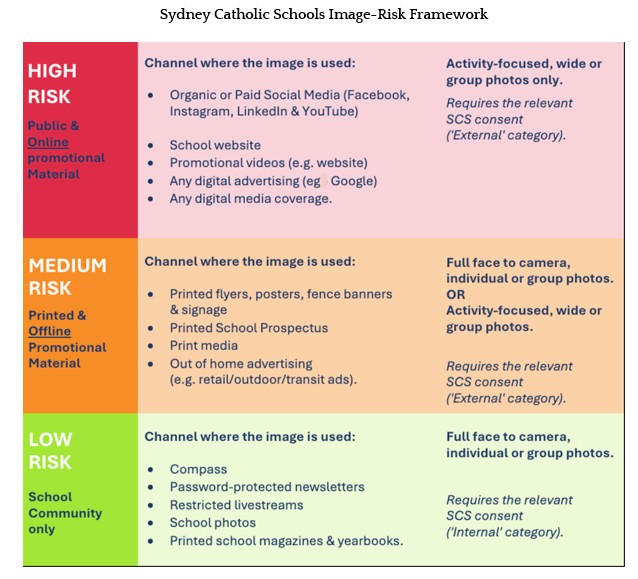
Some guidance is in development in regard to our system position on the use of student images in schools, in particular in relation to social media. The overwhelming majority of young people (especially those 16 years and older) are on some form of social media and they share images and details about their lives frequently and can subsequently be accessed by large portions of the community. At school, we use it as a tool to celebrate student achievement and communicate with families about all of the amazing things our students do on a daily basis. However, there is a sinister side to social media and the sourcing of images and use of AI and deepfake programs are becoming problematic across all parts of society.
If a student were to obtain and subsequently alter and/or share a student or staff member’s image without consent in any way, it is likely to result in the student spending a considerable amount of time away from school or potentially never returning to our school. I encourage all parents to have a chat with their son about the implications of undertaking these kinds of activities. There are laws against image-based abuse and even those under the age of 16 are at risk of severe penalties (i.e. fines or prison or both). Link to government information on this topic can be located HERE.
Moving forward, we will be adopting a more privacy-conscious approach to how we share student images, particularly on public channels such as social media. This means prioritising wider group, activity-focused and less identifiable images wherever possible, while continuing to celebrate student learning, faith and achievements. We will be endeavouring to choose images where there are fewer details visible on the individual’s face, for example, through a side or rear angle, looking down or away from the camera. The person may still be recognisable to people that know them. We will share more detail over the coming weeks and months as direction is given and we move to a more low-risk use of student and staff images.
Respice Finem
Mr David Sullivan
Principal