Future-Ready Schools: Marketing Smarter with AI
With the 2025 edition of Face-2-Face Magazine just moments away from dropping, we are thrilled to share a sneak peak into an article from your very own WA Chapter colleague, Margo Bastow!
(And keep an eye on your inbox for the F2F Magazine launch – there are a couple more fabulous articles from fellow WA Chapter Members … plus over 20 contributions from across Australia, New Zealand and Asia!)

Margo Bastow CPM GAICD F.EdPlus
Director of Community Relations
Santa Maria College WA
Budgets are tight. Teams are lean. Expectations keep climbing. For marketers in education, the pressure to “do more with less” has never been greater.
Artificial Intelligence (AI) is beginning to offer us a way forward — not just for speed, but for smarter, higher-quality work. Its promise lies in freeing people to focus on the most human parts of the job: building relationships, telling stories, and shaping the future of our schools.
“AI is not about speed for speed’s sake. It is about working better and smarter.”
Moving Beyond Dabbling
At the 2025 WA Chapter Summit, I introduced the CRIT method for prompting — Context, Role, Interview, Task (a framework created by Leadership coach Geoff Woods). It turns even a basic chatbot into a purposeful partner. Since then, AI has accelerated fast. The question is no longer whether institutions should use it, but how confidently and consistently they will.
Following, are the five levels of AI where educational institutions need to be building skills. The key is not to stop at Level 1. Each level builds on the last. The schools that thrive will be those that keep progressing.
- Level 1. LLMs (Chatbots). Most institutions start with ChatGPT or Gemini for quick drafts and summaries. They are useful but limited, struggling with memory and consistency. Better prompting, such as CRIT, matters for purposeful results.
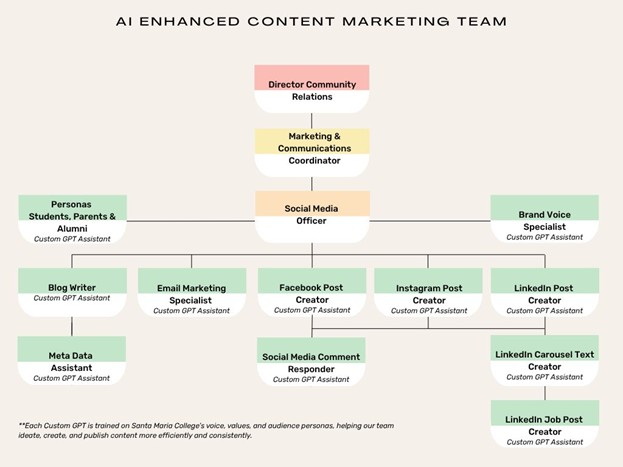
- Level 2. Custom GPTs + Projects. Together, these move beyond one-off chats into reusable systems. Custom GPTs become digital teammates, shaped to your institution’s voice and values. Projects act like a personal filing cabinet, holding context, resources and your GPTs in one place so you do not start from scratch every time. Both features are available on the free plan, although paid plans offer higher limits and more capability. This level brings consistency and time savings, helping staff spend less time repeating work and more time building relationships that matter.
- Level 3. Workflows. Tools like Zapier, Make, or n8n connect AI to your existing systems, automating tasks such as routing enquiries, updating databases, or triggering Communications. They free staff for higher-value work while ensuring routine processes happen reliably.
- Level 4. AI Agents. Unlike workflows that follow recipes, agents work autonomously toward a goal. You set the outcome, such as “run an Open Day campaign,” and the agent decides the steps: drafting emails, segmenting audiences, posting reminders, and adjusting based on engagement.
- Level 5. Vibe Coding. On the horizon, this will allow you to describe an App in plain English, and AI builds it for you. Early platforms like Lovable, Replit, and Reverence AI are already showing what’s possible. Imagine creating a parent engagement tool without writing a single line of code.
“At its best, AI is not replacing our people but amplifying their capacity to do the work only humans can do.”
The Leadership Imperative
The age of casual experimentation is fading. The marketers who thrive will be those who move beyond dabbling, investing in stronger systems, clearer strategies, and more confident teams.
“AI will not wait for us. The question is… will we step up and shape it, or be shaped by it?”
Key Tips
- Master prompting. Clear input creates accurate, values-aligned output.
- Build systems. Use Custom GPTs + Projects (paid plans) to reduce repetition and scale consistency.
- Keep progressing. Move beyond LLMs toward Workflows, Agents, and Vibe Coding to stay ahead.