


From the Head of Learning and Teaching
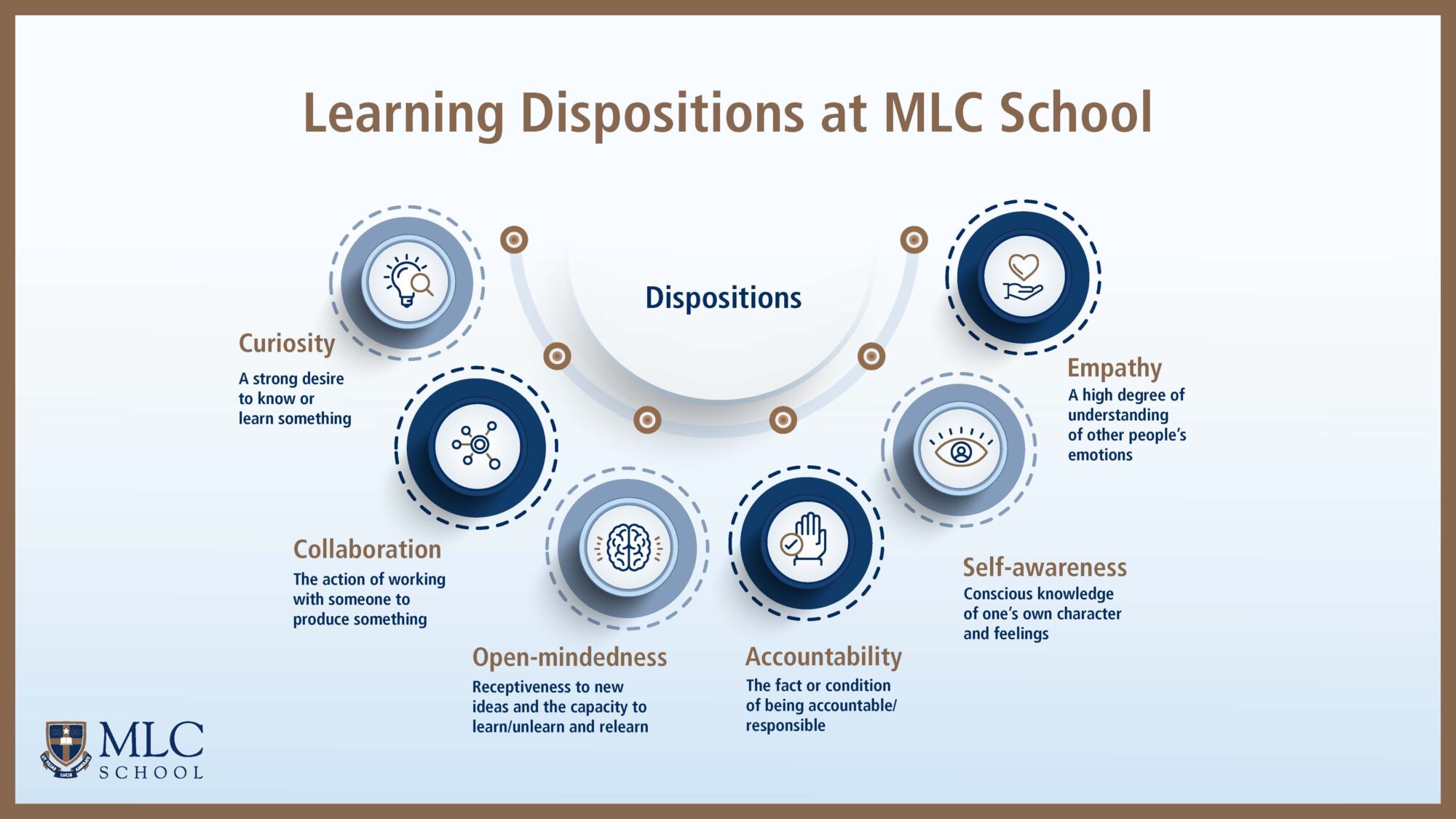
Earlier this year we launched the MLC School Learning Dispositions. Across the three domains of emotional, cognitive, and ethical and moral intelligence, we seek to develop the dispositions of curiosity, collaboration, open-mindedness, accountability, self-awareness, and empathy in the MLC School girl.
Over the past two terms the teaching staff have been engaged in a project that breaks each of the dispositions into what it looks like, sounds like, and feels like in all aspects of school life. From this we are mapping each disposition as a progression of learning from Pre-K to Year 12. This will be the foundation of the common language we all speak in relation to learning at MLC School.
In parallel with this we are looking at ways we can measure the impact of the work we are doing. It is important to monitor and reflect on changes as they are implemented to ensure they bring about the desired growth in each girl.
This week all students in Year 3 to Year 10 have completed a short survey entitled Myself As a Learner. This will provide us with baseline data from which we can measure the impact of changes to how we approach learning and teaching at MLC School. The data will not be shared with any organisations external to MLC School and all individual surveys will be deidentified and the data aggregated before being presented to staff.
The Myself As a Learner scale has been developed in the UK in response to a growing awareness of the increasingly central role played by a person’s self-perception in contributing to motivation and achievement in in school (Burden, 2014) and the need for a valid and reliable instrument that is available to teachers in this area. The design is based on an extensive review of literature in the area of self-concept which is different to self-image and self-esteem. It recognises that how students feel, think, and feel about themselves is closely linked with success and failure in all aspects of their life. Additionally, it is recognised that student self-assessment has a powerful influence on the development of student autonomy and agency (Higgins et al, 2011).
Students were presented with a series of 20 statements about learning and then asked whether this was definitely true about them, a bit true about them, sometimes true and sometimes not, not very true or definitely not true. Some examples included:
- I like having problems to solve
- When I’m given new work to do, I usually feel confident I can do it
- I think that problem solving is fun
- I know the meanings of lots of words
- I find a lot of schoolwork difficult
– Linda Emms
Head of Learning and Teaching