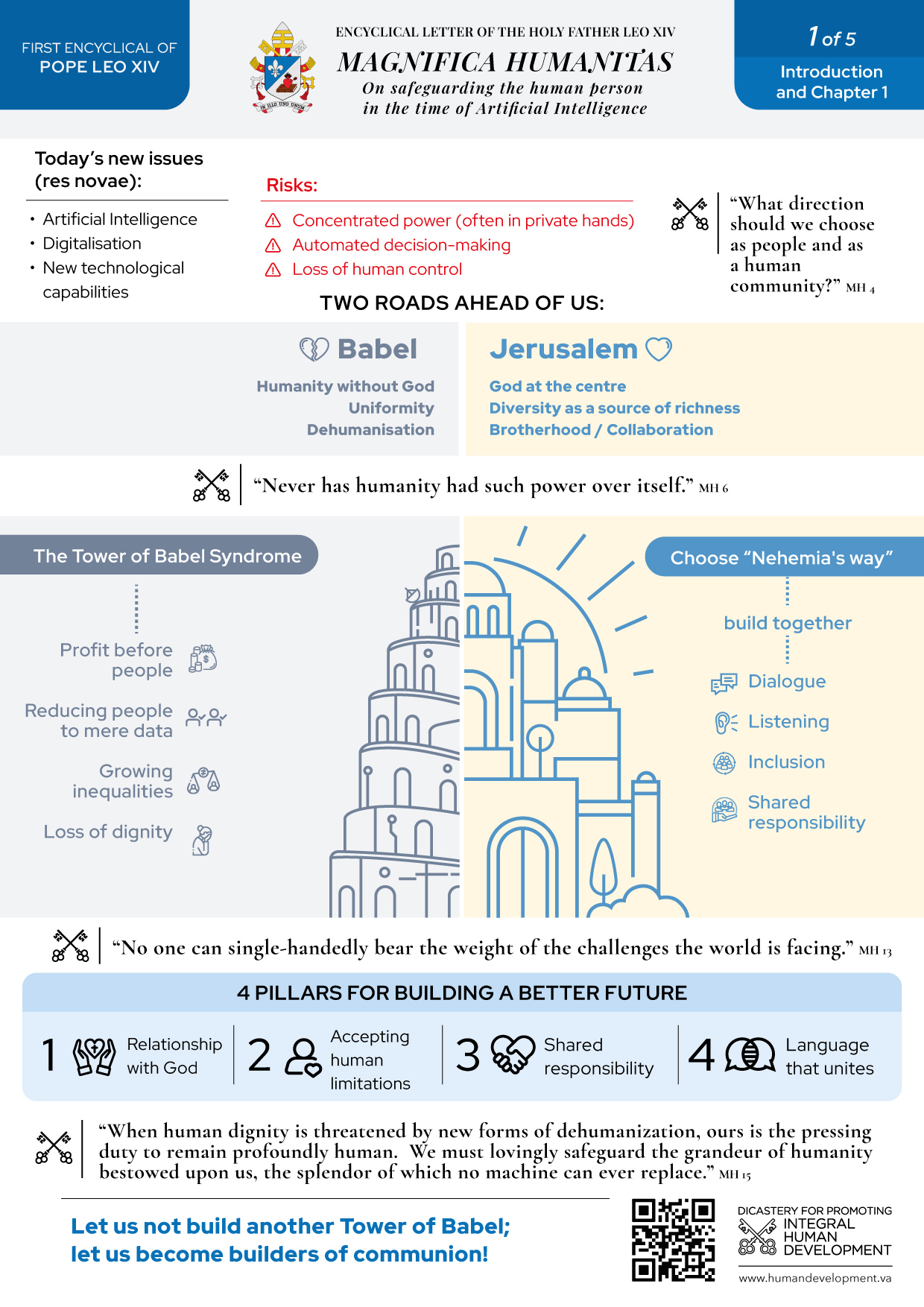
From the Assistant Principal: ‘Magnifica Humanitas’ – How Young People Can Flourish in the Age of AI
Pope Leo XIV has recently released his first encyclical Magnifica Humanitas. Pope Leo XIV, in presenting to the world and to all the people of God the importance of caring for the human person in the time of Artificial Intelligence. He said “I invite all members of the Church and of the human family: let us learn to listen to one another, face the present challenges with courage, and cooperate in building a more human and fraternal society … Please take with you a commitment to stay awake and, as ‘artisans of hope’, to keep on building the worksite of our time. May the Spirit of the Risen Lord Jesus sustain our work together.” (Pope Leo XIV, 2026)
The encyclical invites us to safeguard something precious: the human person, especially the dignity of children and young people at a time when artificial intelligence is reshaping everyday life. The Pope does not treat AI as only a technical issue. He frames it as a moral and educational challenge: “what kind of person, communities, and future will we be when technology becomes part of how we think, relate, and decide?” (Pope Leo XIV, 2026)
For school communities, this is more than a metaphor. It means: AI can become another “tower” that flattens people into outputs, metrics, and efficiency. Or it can become a tool that supports communion helping students grow into truthful, free, and responsible persons.
Central to the encyclical is a clear principle: it is human intelligence, conscience and freedom that must guide technical innovation and determine how technology is used and limited. That matters for young people, because AI is not only something to “use.” It is also something that can shape habits of mind:
- what students learn to prioritise,
- how they interpret information,
- and whether they develop the capacity to judge truth and goodness for themselves.
In addition to the encyclical’s vision, Pope Leo XIV has directly addressed the safeguarding of minors in AI. He warns that children and adolescents are particularly vulnerable to manipulation through AI algorithms that can influence their decisions and preferences. He emphasises that safeguarding cannot be reduced to regulations alone; it also requires “digital education.” Adults must rediscover their vocation as “artisans of education” and provide daily, ongoing support—helping young people recognize risks and approach digital life as a means of strengthening responsible choices.
The encyclical concludes with a Marian lens: as Mary guides believers to see the world from “the viewpoint of the little ones,” we are invited to become “weavers of hope” so that, even in the era of AI, the Holy Spirit can build a civilisation of love.
Mrs Melissa Vassallo, Assistant Principal